
African Farm Silo Procurement Guide: China Custom Solutions by Burt Machinery



(YorkPedia Editorial):- Hanzhong, Shaanxi Aug 7, 2026 (Issuewire.com) – Securing reliable grain storage is the crucial first step for processing facilities across Africa, where post-harvest losses, fluctuating climate conditions, and complex logistics challenge profitability. For commercial maize and wheat operations, selecting the right equipment involves more than just evaluating nominal tonnage or basic structural dimensions. Buyers need comprehensive storage systems that integrate seamlessly with cleaning, milling, and packaging lines. Finding a reliable China Custom Farm Silo Supplier is essential for ensuring that raw materials remain secure, properly conditioned, and ready for continuous processing throughput. Hanzhong Burt Machinery Equipment Co., Ltd. provides integrated solutions that bridge the critical gap between raw grain storage and finished flour production, ensuring that investments in milling infrastructure are supported by robust front-end material management.
Farm Silo Procurement Starts with Grain, Capacity, Climate, and Integration
Investing in a farm silo requires a comprehensive evaluation of the specific grain variety, available storage capacity, anticipated storage duration, and the unique demands of the local climate. Facility operators must also consider power availability, site conditions, and precisely how the storage unit will interface with the cleaning or milling systems. Grain characteristics, particularly the physical properties of maize and wheat, dictate the specific environmental controls needed to prevent spoilage and maintain optimal processing quality. A silo designed for dry, temperate environments will fail to protect maize in regions characterized by high humidity and aggressive temperature swings.
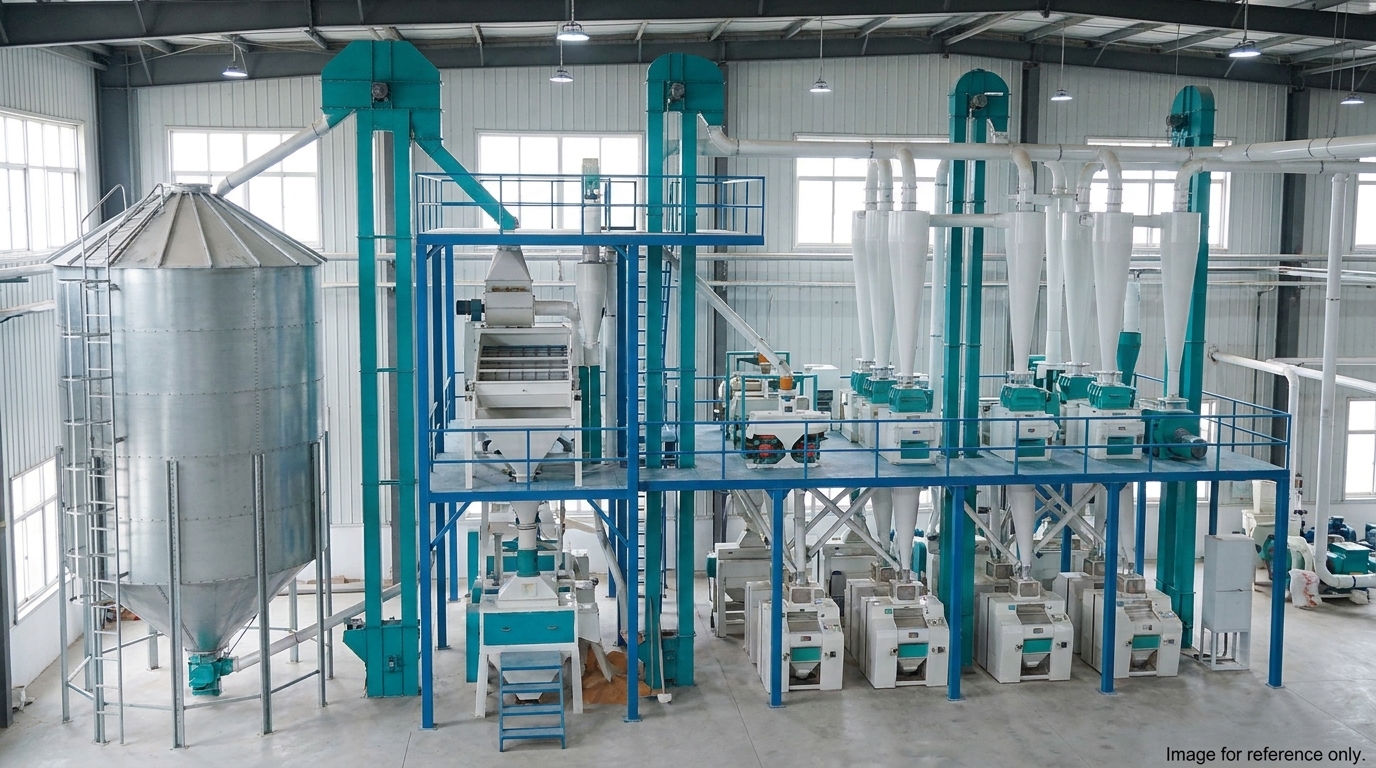
Burt Machinery approaches grain storage as the foundational component of a complete processing system rather than an isolated structural asset. For example, their 100 to 200 tons per day maize production lines incorporate silo or warehouse storage for raw grain immediately before the initial cleaning and dampening stages. This approach ensures that storage is a coordinated frontend process that feeds directly into the milling line with consistent volume and quality. Food and Agriculture Organization guidelines indicate that grain temperature and moisture are core variables in storage stability. Consequently, integrating low-volume aeration into the silo design is a critical requirement for regulating internal temperatures and reducing the risk of biological deterioration.
Usable Capacity Must Reflect Throughput and Operating Reserve
Calculating the appropriate silo size involves more than a simple assessment of total expected harvest volume or a static inventory target. Usable capacity must be determined by analyzing daily grain flow, seasonal procurement patterns, target storage days, and the specific test weight of the grain being processed. Procurement teams must also factor in operational headspace, discharge rates, and the required production buffer for the milling line. A silo that accurately matches the processing speed prevents production bottlenecks and ensures that the facility does not experience costly material shortages during peak operational shifts.
The equipment engineering process at Burt Machinery positions storage immediately upstream of critical processing phases, including cleaning, dampening, degerming, and grinding. Therefore, the silo’s discharge capacity must directly support the actual throughput of the downstream production line rather than relying merely on a nominal volume rating. Project planning must align milling capacity, factory dimensions, and local voltage standards simultaneously. Designing silos, conveying equipment, and the milling system under a unified framework ensures that the material flow remains consistent and that utility requirements are met without overloading the site infrastructure or causing electrical faults.
Aeration and Monitoring Protect Stored Grain Quality
Grain conditions fluctuate continuously during storage, making proactive environmental management a mandatory aspect of any silo procurement strategy. Equipment specifications must clearly define the aeration systems, temperature monitoring tools, moisture management protocols, inspection access points, and standard operating procedures. Without these fundamental controls, localized hotspots and moisture migration can rapidly degrade the stored harvest, increasing the risk of mold and insect infestation, ultimately rendering the grain unsuitable for high-quality flour production.
The storability of grain is fundamentally tied to its temperature and moisture content. Aeration systems utilize low-volume air pushed uniformly through the grain mass to establish a manageable internal temperature profile. This thermal regulation is essential for mitigating condensation and suppressing biological activity that leads to spoilage. Furthermore, operators must conduct regular checks on grain moisture and temperature throughout the storage period. Sudden temperature increases often serve as the earliest warning sign of spoilage, necessitating immediate intervention. Incorporating robust monitoring equipment and routine inspection schedules into the overall facility plan protects the raw material investment and ensures a consistent, high-quality feed for the milling operation.
Conveying, Cleaning, and Discharge Must Form One Material-Handling Plan
A successful grain storage facility requires a unified approach to material handling that eliminates bottlenecks between distinct phases of operation. The procurement plan must coordinate the entire process, including grain reception, pre-cleaning, elevating, distribution, aeration, discharging, and the final transfer to the processing line. Any restriction, mechanical failure, or capacity mismatch at these interface points will limit the overall throughput of the entire milling plant, stranding valuable capacity.
For smaller commercial setups, such as a 20 tons per day sifted maize flour line, the system must efficiently elevate the discharged grain directly into the primary cleaning equipment without inducing kernel damage. In larger industrial applications, such as a 100 to 200 tons per day production line, the integration becomes even more critical. The storage discharge must synchronize perfectly with cleaning, dampening, degerming, milling, packing, and stacking operations to maintain a continuous production rhythm. Technical proposals from equipment manufacturers must specify conveying capacities, layout dimensions for intake and discharge, dust control connections, control logic, and the exact sequence of operations. This level of detail guarantees that the flow of grain from the silo precisely matches the consumption rate of the downstream milling equipment.
Supplier Documentation Must Define Structure, Installation, and Service Boundaries
When sourcing customized grain storage solutions, the contractual and technical documentation must be exhaustive to protect the buyer’s investment. Buyers should expect clear definitions regarding the silo structure type, construction materials, protective coatings, and foundation load requirements. The documentation must also detail environmental design parameters, aeration and monitoring components, the extent of the conveying systems, installation responsibilities, commissioning procedures, maintenance schedules, warranty terms, and spare parts availability.
The service scope provided by Burt Machinery encompasses the entire project lifecycle, including factory design, layout planning, equipment selection, manufacturing, installation, operator training, and commissioning. This comprehensive service model allows the company to manage the complex engineering coordination required between the storage units and the milling systems. In projects lacking standardized silo parameter packages, the technical annexes of the contract must explicitly list dimensions, design standards, load capacities, component lists, and acceptance criteria. Clear boundaries of responsibility ensure that the customized storage solution can be manufactured, installed, and validated successfully on site, backed by a standard one-year machine warranty.
Burt Machinery Can Integrate Storage with a Grain Processing Project
Effective agricultural processing relies on seamless transitions between bulk storage and active production. Burt Machinery offers the capability to unite grain storage with receiving, cleaning, dampening, milling, and packaging into a single, cohesive processing project. This integrated approach simplifies procurement, reduces compatibility risks between different equipment vendors, and ensures that every component of the facility operates in harmony to maximize yield.
By explicitly positioning silo storage at the front end of complete production lines, the project design effectively coordinates storage management, conveying mechanisms, and downstream processing equipment. Buyers looking to develop new facilities or upgrade their existing grain infrastructure can visit https://www.burtmachinery.com/ to submit their specific operational requirements. By detailing grain varieties, capacity needs, target storage duration, site dimensions, climate data, conveying preferences, aeration requirements, and downstream processing goals, operators can initiate a detailed consultation for a customized, integrated solution that protects their harvest and drives processing efficiency.
Media Contact
Hanzhong Burt Machinery Equipment Co., Ltd.
This article was originally published by IssueWire. Read the original article here.
