
Top Rated CB-Certified Power Extension Lead: Inside Heikki Technology’s Full-Cycle Quality Testing



(YorkPedia Editorial):- Jiangmen, Guangdong Aug 21, 2026 (Issuewire.com) – In modern electrical infrastructure and global consumer electronics markets, international compliance and product safety are paramount. Electrical safety standards set by the IECEE CB Scheme provide a unified framework for verifying that power distribution equipment meets stringent international safety and reliability metrics. Among high-demand electrical accessories, the Top Rated CB-Certified Power Extension Lead serves as a critical interface between household or commercial equipment and power grids worldwide. Often integrated into multi plug extension sockets, these devices must manage substantial thermal loads, voltage fluctuations, and continuous electrical contacts while preventing short circuits, electrical fires, and user exposure to live components. As global buyers and engineering procurement teams seek verified quality, tracing the manufacturing and testing protocols behind high-performance extension leads reveals how rigorous quality assurance underpins international market acceptance.
Heikki Technology, an established enterprise with over three decades of professional manufacturing experience in power strips and adapters based in Jianghai District, Jiangmen, Guangdong, operates a self-owned production facility covering over 30,000 square meters. Recognized as a Specialized, Refined, Unique, and Innovative SME and a High and New-Technology Enterprise (HNTE), the company integrates complete R&D, structural design, manufacturing, and international trade operations certified under ISO 9001, ISO 14001, and ISO 45001 standards.
To understand how a multi-plug extension socket achieves reliable operation under diverse environmental conditions, it is necessary to examine the engineering and full-cycle quality control methodologies implemented throughout the manufacturing flow.
A. Raw Material Selection and Incoming Quality Control
The foundation of a reliable power extension lead lies in the molecular and metallic properties of its raw materials. During the incoming material inspection phase, raw polymers and conductive alloys undergo rigorous lab testing to ensure compliance with international safety specifications:
- Flame-Retardant Polycarbonate Housings: Outer enclosures are molded from high-grade, engineering-grade polycarbonate capable of withstanding high-temperature glow-wire testing up to 750°C in accordance with IEC standards. Material samples undergo melt flow index testing and heat deflection temperature verification to prevent structural warping or combustion under abnormal thermal overload conditions.
- High-Purity Phosphor Bronze Conductors: High conductivity and elasticity are critical for long-term plug retention. Internal busbars utilize high-purity integrated phosphor bronze strips rather than lower-grade spliced brass. Chemical composition analysis via optical emission spectrometry verifies alloy purity, while micro-hardness and tensile strength testing ensure that socket contacts maintain spring tension over thousands of insertion and withdrawal cycles.
- Pure Copper Wiring: Cable assemblies utilize 100% pure oxygen-free copper conductors enclosed in heavy-duty PVC insulation, subjected to spark testing and conductor resistance verification to prevent resistive heating and voltage drop along extended cord lengths.
B. Precision Stamping, Tooling, and Sub-Assembly Inspection
Once materials pass preliminary verification, components transition into automated stamping and sub-assembly processes where mechanical tolerances directly impact electrical performance:
- Continuous Strip Stamping: Integrated internal conductor strips are formed using high-precision automated stamping dies. Eliminating internal solder joints between individual outlet contacts significantly reduces internal electrical resistance and eliminates cold-solder joint failures. Dimensional checks are performed using automated optical measurement systems.
- Child-Safe Safety Shutter Assembly: To meet modern safety standards, multi-plug extension sockets incorporate independent mechanical child-safety doors over internal contacts. Testing at this stage measures the insertion force required by safety shutters, ensuring they remain closed against single-pole probing (such as screwdrivers or small metallic objects inserted into single slots) while opening smoothly when a standard plug is inserted simultaneously across neutral and live pins.
- Smart USB Module Integration: For extension leads featuring integrated step-down conversion modules–such as dual smart USB charging ports–PCB assemblies undergo automated optical inspection and in-circuit testing. Voltage regulation, ripple suppression, and over-current protection circuits are verified prior to final enclosure assembly.
C. In-Line Automated Assembly and Process Control
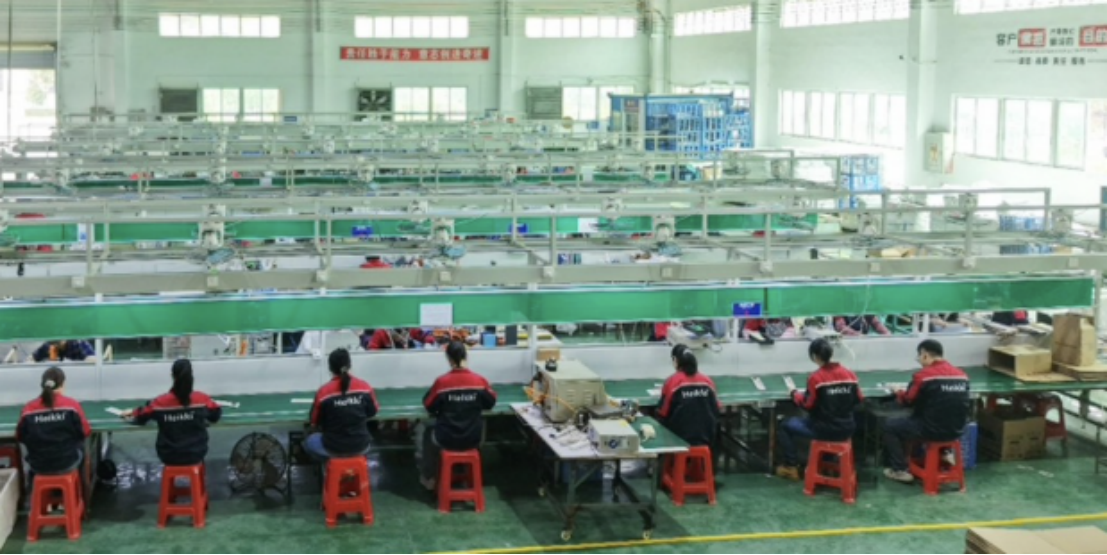
During main line assembly, semi-finished power strips move through semi-automated and automated workstations monitored by continuous in-process quality control protocols:
- Ultrasonic Welding and Mechanical Enclosure Assembly: Upper and lower housing shells are permanently joined using ultrasonic welding or high-torque tamper-resistant screws, preventing unauthorized user access to internal high-voltage components. Joint structural integrity is verified through drop testing and mechanical impact resistance checks.
- Overload Protector Calibration: Built-in push-button thermal overload protection switches undergo current injection testing. The bi-metallic tripping mechanism is calibrated to automatically interrupt circuit power when total load exceeds rated limits, such as 2500W at 250V voltage thresholds, protecting home appliances and commercial loads from catastrophic thermal overload.
- Cord Strain Relief and Anchorage Testing: Cable entry points are fitted with reinforced strain relief bushings. Pull and torque testing verifies that the power cord withstands longitudinal mechanical pull forces exceeding 100N without compromising internal terminal connections or stripping insulation.
D. 100% End-of-Line Electrical Safety Testing
Before packaging, every individual extension lead undergoes non-destructive 100% automated electrical testing on specialized end-of-line test stations. Units failing any single parameter are automatically rejected and segregated:
- Dielectric Voltage Withstand Testing: High voltage, typically 2000V AC to 3000V AC, is applied between live/neutral conductors and the ground wire or external housing for a specified duration. This tests the breakdown strength of internal insulation and ensures zero dielectric breakdown or dangerous leakage current.
- Insulation Resistance Measurement: High DC voltage, such as 500V DC, is applied across conductor pairs to measure insulation resistance, requiring values well above 5 megohms to verify that no moisture, dust, or material defects contaminate the internal chamber.
- Ground Continuity and Earth Bonding: For grounded power extension leads, low-resistance high-current continuity tests verify that the protective earth path from the plug earth pin to every socket earth contact measures below 0.1 ohms, guaranteeing rapid trip triggering of main distribution circuit breakers in the event of an earth fault.
- Full Operational and Polarity Check: Automated equipment confirms correct line, neutral, and ground wiring polarity across all socket outlets while verifying USB port output voltage, such as steady 5V DC regulation, and standby power consumption.
E. Environmental Stress, Life Cycle, and Final Quality Assurance
To maintain compliance with CB Scheme standards and regional certifications across global markets, batch sampling is subjected to destructive and accelerated life-cycle testing in central testing laboratories:
- Thermal Endurance and Temperature Rise Testing: Sample extension cords are operated under continuous 100% to 125% full load capacity inside temperature-controlled environmental chambers. Thermocouples monitor junction temperatures at conductor strips, plug pins, and housing walls to confirm that temperature rise remains well within the limits defined by IEC standards.
- Mechanical Endurance and Plug Insertion Cycling: Automated pneumatic plug testing rigs insert and withdraw standard regional plugs into socket outlets for 5,000 to 10,000 continuous cycles. Contact resistance and spring retention force are re-measured post-test to guarantee reliable mechanical gripping without loose contacts or arcing over extended product lifespans.
- Glow-Wire and Needle Flame Testing: Plastic components are subjected to direct flame exposure and heated wire elements in specialized burn chambers to verify self-extinguishing capabilities within 30 seconds of ignition source removal.
- Packaging, Barcode, and Regional Marking Audit: Final Quality Assurance teams verify that outgoing cartons meet international shipping standards, carrying appropriate regional certification marks alongside accurate electrical ratings, batch tracing codes, and user instructions.
Engineering Case Analysis: Universal Power Strip with USB Ports
To contextualize how full-cycle testing translates into practical product performance, consider a flagship multi-plug configuration: a universal power strip featuring 5 multi-region socket outlets, 2 smart USB charging ports, a 3-meter heavy-duty power cord, and a rated power capacity of 2500W.
Designed for versatile home and office applications, this model incorporates integrated child-safety shutter doors across all 5 main socket outlets. The housing is constructed from flame-retardant PC material, complemented by high-purity internal copper busbars designed to eliminate solder points. During testing, the 2500W maximum load threshold is validated under continuous current draw to ensure stable power delivery for sensitive electronics and heavy appliances alike. Dual smart USB outputs deliver regulated DC power with built-in over-current and surge protection, ensuring multi-device charging without voltage drop or excessive heat accumulation.
Conclusion and Corporate Alignment
The engineering rigor required to produce a Top Rated CB-Certified Power Extension Lead underscores the importance of comprehensive quality control across all stages of development and manufacturing. By implementing systematic incoming material checks, in-process control, automated end-of-line electrical testing, and laboratory reliability auditing, manufacturing facilities ensure that power distribution products meet international safety benchmarks across diverse regulatory markets.
Through continuous technological innovation, strict adherence to international safety frameworks, and sustained partnerships with global importers, distributors, and retail chains, modern electrical manufacturing continues to raise the baseline for global power safety.
For detailed technical specifications, product catalogs, and corporate inquiry information, visit the official enterprise website:
Source :Jiangmen Heikki Technology CO.,Ltd
This article was originally published by IssueWire. Read the original article here.
