
Complete Buyer’s Guide to Custom Outdoor Self Service Kiosk Company with IP65 Weatherproof Standards


(YorkPedia Editorial):- Shenzhen, Guangdong Jul 29, 2026 (Issuewire.com) – Outdoor self-service terminals are fundamentally reshaping how industries manage ticketing, drive-thru ordering, wayfinding, and interactive public communications. Deploying digital hardware in uncontrolled external environments presents severe engineering challenges, including intense solar glare, wide ambient temperature fluctuations, and exposure to moisture and dust. Partnering with a specialized Custom Outdoor Self Service Kiosk Company ensures that deployed systems combine high-brightness display performance with structural resilience. An effective Outdoor Self Service Kiosk integrates industrial-grade touch panels, active thermal regulation, dynamic brightness adjustment, and reinforced enclosures to deliver high operational uptime across diverse public deployments.
STEP 1: Understanding Industry Essentials and Core Technical Requirements
Before issuing RFPs or selecting hardware vendors, commercial buyers must understand the primary failure points of outdoor interactive displays. Standard indoor or semi-outdoor commercial monitors frequently fail when subjected to direct weather exposure. Moisture ingress damages electronic components, excessive solar load causes LCD blackening through thermal buildup, and insufficient backlighting renders touchscreens unreadable in direct sunlight.
True outdoor deployments demand hardware designed from the ground up for extreme conditions. Key technical criteria include display panel selection, optical bonding, thermal management, and robust dynamic power handling. Industrial displays must provide high luminance–typically 2,000 to 3,500 nits–coupled with built-in ambient light sensors to automatically adjust output based on real-time lighting conditions. Optical bonding technology laminates the touch glass directly to the LCD panel, reducing internal reflections, eliminating air gaps where moisture can condense, and improving contrast and structural durability.
STEP 2: Evaluating Structural Integrity and the Critical Role of IP65 Weatherproof Standards
The structural design of an outdoor kiosk directly dictates its lifespan and operational reliability. In the Ingress Protection (IP) rating system, the first digit indicates dust protection and the second indicates moisture defense. An IP65 rating signifies complete protection against dust ingress (dust-tight) and protection against water jets projected by a nozzle from any direction.
For outdoor hardware, IP65 protection is essential. Without dust-tight sealing, airborne particulates enter the enclosure and settle on cooling fans, power supplies, and logic boards, causing overheating and short circuits. Water ingress from heavy rainfall, snow, or high-pressure cleaning routines can cause immediate catastrophic electrical failure.
Advanced outdoor enclosures go beyond basic sealing by utilizing marine-grade aluminum, galvanized steel, and specialized anti-corrosion powder coatings. Weatherproof design also requires integrated sealing gaskets, waterproof cable entry points, and double-barrier door construction to maintain IP65 integrity during field servicing.
STEP 3: Assessing Thermal Management, Display Visibility, and TCO
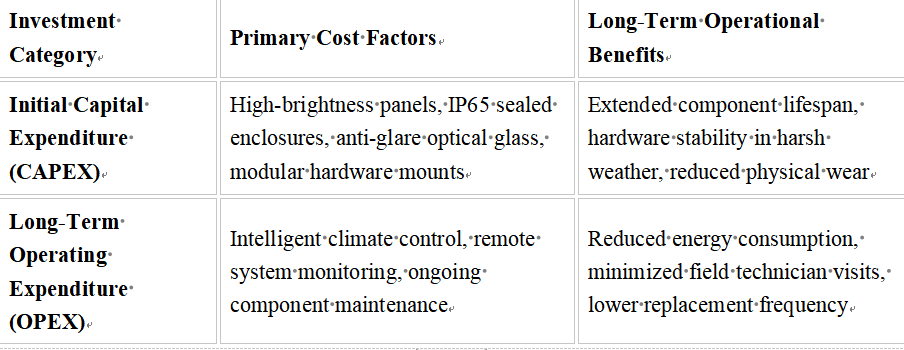
Evaluating total cost of ownership (TCO) requires analyzing both initial capital expenditure (CAPEX) and long-term operating expenditure (OPEX). A low purchase price often leads to higher maintenance costs, frequent display replacements, and operational downtime caused by poor thermal engineering or sub-standard components.
Thermal management is a critical factor in controlling long-term costs. Direct sunlight transfers substantial thermal energy into sealed enclosures. Without efficient heat dissipation, internal temperatures can exceed safe operating limits, leading to display degradation or system shutdown. High-grade kiosks utilize intelligent air-cooling or closed-loop air conditioning systems with ambient temperature sensors. These climate systems automatically regulate internal temperatures while maintaining IP65 sealing, preserving component lifespans.
Display visibility under direct sunlight is equally critical for customer satisfaction. Solutions featuring high-brightness commercial panels, wide viewing angles, and anti-glare, anti-reflective tempered protective glass ensure readability in harsh sunlight without generating excess internal heat.
STEP 4: Identifying Customization Capabilities and Modular Architecture
Standard off-the-shelf kiosks rarely meet the specific operational requirements of complex commercial deployments. Enterprise buyers should partner with manufacturers capable of delivering custom engineering, modular component integration, and flexible branding options.
Leading hardware manufacturers, such as BEST.SDT, integrate full-process design and manufacturing capabilities, including sheet metal fabrication, optical assembly, and environmental stress testing. Modular internal design allows buyers to integrate customized peripherals based on operational needs, such as:
- Multi-point PCAP touchscreens supporting glove and wet-finger interaction
- Integrated EMV credit card readers, NFC payment modules, and QR code scanners
- Receipt printers, barcode readers, and ID verification hardware
- HD cameras and directional speakers for interactive telepresence or drive-thru ordering
- Custom branding, powder-coat color choices, and tailored mounting bases
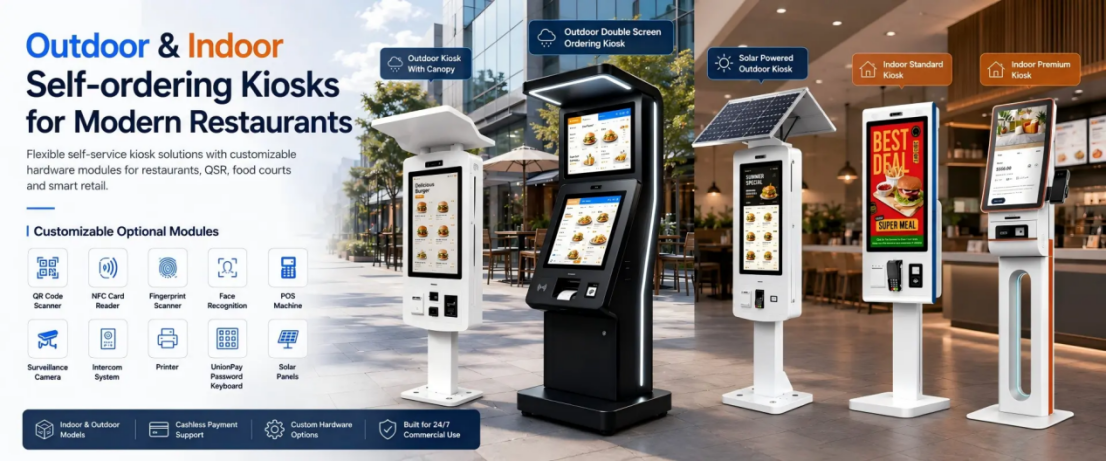
For specialized applications such as drive-thru restaurant environments, high-performance hardware configurations like the outdoor touchscreen ordering kiosk solution demonstrate how custom structural design, sunlight-readable high-nit displays, integrated payment hardware, and IP65 climate control combine to maintain rapid order processing in demanding high-traffic settings.
STEP 5: Verifying Vendor Qualification, Manufacturing Standards, and Field Proven Solutions
The final step in vendor selection involves verifying a manufacturer’s production standards, quality control certifications, and real-world deployment history. Enterprise hardware providers should hold international quality certifications, such as ISO9001, along with product certifications including CE, FCC, and RoHS to ensure compliance with global safety and environmental regulations.
Procurement teams should also evaluate a manufacturer’s vertical integration capabilities. In-house control over sheet metal processing, powder coating, optical bonding, and burn-in testing ensures consistent quality and faster lead times compared to companies that outsource production.
Reviewing past deployments across key sectors provides insight into product reliability. Deployments in quick-service drive-thrus, public transit stations, smart park wayfinding systems, and outdoor retail access points demonstrate a manufacturer’s ability to engineer hardware built for diverse outdoor environments. High-level technical support, long-term component availability, and clear warranty terms further ensure that deployed hardware yields a reliable return on investment over its multi-year operational lifecycle.
To learn more about custom outdoor self-service kiosk manufacturing, technical specifications, and outdoor display solutions, visit: https://www.bestlcdled.com/
Source :SHENZHEN BEST SPECIAL DISPLAY TECHNOLOGY CO. , LTD
This article was originally published by IssueWire. Read the original article here.
