
Liquid Cooling vs. Traditional Air: Global Deployment of OEM Liquid Cooling Manifold Exporter EXTRCOOL


(YorkPedia Editorial):- Foshan, Guangdong Jul 29, 2026 (Issuewire.com) – Optimizing High-Density Data Center Thermal Management
Inside a modern high-density data center running intensive artificial intelligence workloads, the hum of forced-air cooling fans often signals a severe engineering bottleneck. As individual server racks cross high thermal thresholds, traditional mechanical air systems struggle to move heat away fast enough, forcing facility managers to lower compute density or risk equipment throttling. When internal chassis temperatures spike, hardware automatically reduces processing speed to prevent permanent damage, leading to wasted energy and reduced performance. In response to these operational physical limits, infrastructure builders are transitioning to direct-to-chip and fluid-based thermal architectures. Within these advanced cooling setups, the fluid distribution system plays a foundational role in maintaining continuous operational stability across high-performance computing clusters.
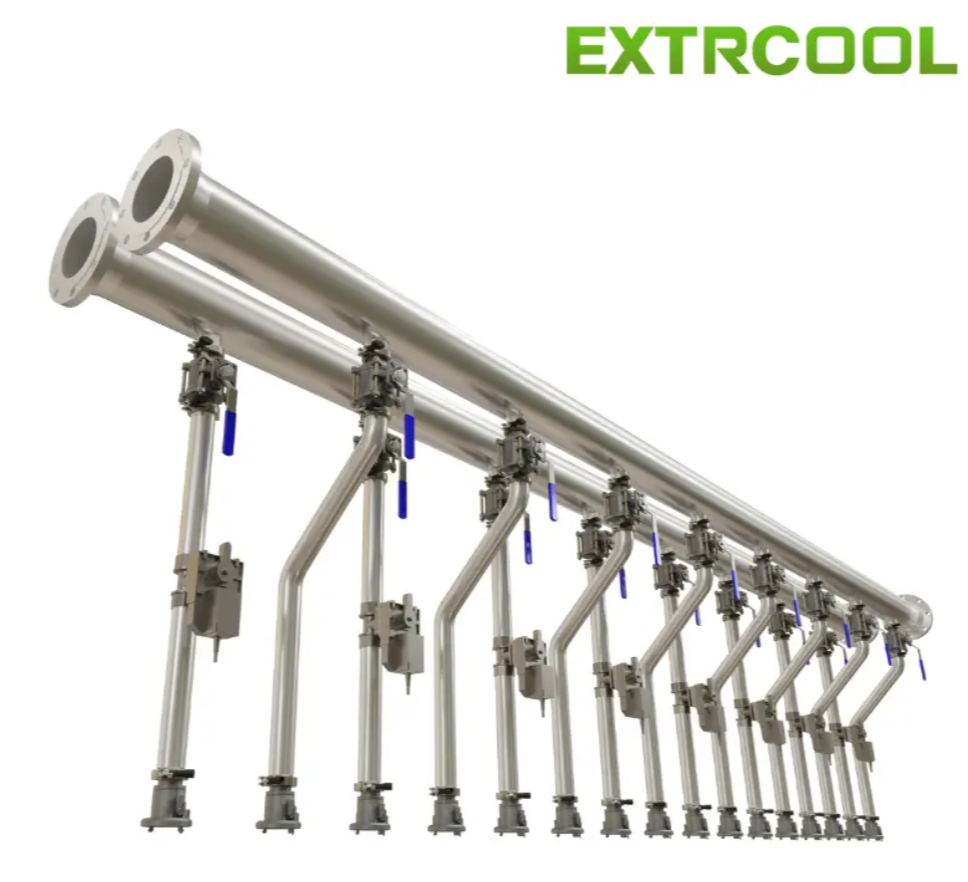
As an established OEM liquid cooling manifold exporter, Extrcool Industry Limited supplies high-precision fluid distribution units engineered to transport dielectric and aqueous coolants straight to server racks. By replacing bulk air circulation with targeted liquid distribution, facility operators eliminate localized hot spots while maintaining uniform temperature profiles across every row of computing hardware. Beyond data centers, these fluid distribution components find practical applications in energy storage power stations, telecommunications networks, server racks, and industrial temperature control systems, as well as commercial refrigeration services for cold storage rooms.
Thermal Efficiency and Power Density Comparison
The fundamental difference between liquid cooling and traditional air systems stems from basic heat transfer physics. Air possesses a relatively low specific heat capacity, meaning large volumes of air must move continuously to absorb moderate amounts of heat. In a standard air-cooled row, high-volume computer room air handler units blow chilled air through raised floors or containment aisles. As rack power densities increase beyond twenty to thirty kilowatts, air speed requirements become impractical, creating turbulent airflow patterns and severe temperature gradients across server blades.
A specialized fluid distribution header eliminates internal airflow limitations by circulating liquid coolants directly alongside dense server heat sources. Water and glycol mixtures carry heat away much more effectively than air at equivalent flow volumes. EXTRCOOL designs and manufactures OEM liquid cooling manifold hardware in multiple form factors, including rack-mounted, ceiling-suspended, over-floor, and underfloor configurations. Built with optimized internal flow channel geometries and balanced port sizing, these manifold systems ensure balanced coolant distribution across every connected cold plate. This uniform fluid dynamic prevents thermal throttling on high-load processors, allowing servers to run continuously at nominal compute speeds without localized overheating.
Energy Efficiency and Operational Expenditure Impacts
Power consumption in traditional air-cooled facilities remains a heavy financial burden for facility managers. Large fan arrays, chillers, and compressor systems require substantial electrical power just to move air through the building. In standard air-cooled setups, Power Usage Effectiveness ratios frequently exceed 1.3, meaning over thirty percent of total facility electrical power goes toward thermal management rather than actual computing tasks. Over time, these ongoing electrical demands drive up operational expenditure and complicate corporate sustainability goals.
Integrating fluid distribution piping into a complete liquid cooling topology drastically reduces auxiliary energy requirements. Liquid systems operate efficiently at higher fluid inlet temperatures, enabling longer periods of free cooling using dry coolers rather than mechanical chillers. Liquid cooling manifold solutions from EXTRCOOL, paired with advanced air-liquid cooling distribution units, liquid-liquid CDUs, rear door heat exchangers, and secondary piping, enable data center deployments to achieve PUE ratings below 1.05. This architectural shift yields energy savings exceeding forty percent compared to conventional air infrastructure. Over a multi-year equipment lifecycle, lowered utility bills directly offset initial hardware upgrades, offering data center owners a predictable path toward reduced operational costs.
Global Customization, Standards Compliance, and Field Deployment
Deploying thermal equipment across international jurisdictions presents complex engineering and regulatory challenges. Data center layouts vary widely in spatial constraints, rack dimensions, fluid connector types, and local building codes. Traditional air conditioning equipment often lacks the modular flexibility needed for retrofit projects or non-standard rack densities, forcing engineers into expensive structural modifications.
Extrcool Industry Limited directly addresses complex global deployment needs through comprehensive original equipment manufacturing services and tailored engineering support. The company provides tailored manifold designs, allowing engineering teams to specify custom port counts, thread standards, quick-disconnect fittings, tube diameters, and mounting bracket positions. As a liquid cooling manifold exporter, the organization has supplied components across more than 100 countries and regions. With over 4 million liquid cooling devices installed worldwide and total project power exceeding 10 gigawatts, these field deployments demonstrate consistent manufacturing precision and cross-border supply chain reliability.
Comprehensive Engineering Services and Future Technological Directions
The successful delivery of modern liquid cooling infrastructure extends far beyond physical hardware manufacturing alone. Facilities require rigorous fluid compatibility testing, pressure drop calculations, and long-term corrosion prevention protocols. Technical support encompasses end-to-end guidance, from initial CAD modeling and thermal fluid simulations to pressure testing and post-installation technical evaluation. In addition to high-performance data center cooling, Extrcool Industry Limited maintains dedicated manufacturing operations for commercial refrigeration and cold storage equipment, delivering reliable freezer and chiller solutions for food logistics, commercial catering, and industrial cold storage applications.
Looking ahead, research and development teams at EXTRCOOL are focusing on advanced two-phase liquid cooling technology. By utilizing phase-change working fluids, two-phase systems achieve ultra-high heat flux density dissipation with thermal transfer efficiency several times higher than single-phase liquid cooling. This continued technological focus supports the ongoing development of computing infrastructure toward lower PUE values and higher energy efficiency.
The Transition to High-Density Thermal Architecture
As compute density continues to rise, relying on forced air for thermal management is becoming increasingly impractical for modern computing facilities. Transitioning to fluid distribution systems allows operators to lower power usage effectiveness, stabilize internal rack temperatures, and optimize long-term operational costs. Through precision manufacturing, custom engineering, and certified quality controls, Extrcool Industry Limited delivers global liquid cooling manifold solutions designed for high-density environments.
Further information regarding liquid cooling products and custom engineering services is available at https://www.extrcool.com/.
This article was originally published by IssueWire. Read the original article here.
