
Complete Selection Guide for Advanced Artificial Flower Arrangement Service: Insights from Yongnuo for The RomaSposa



(YorkPedia Editorial):- Kaifeng, Henan Jun 24, 2026 (Issuewire.com) – At the recent RomaSposa international wedding exhibition, European bridal boutique owners and event designers expressed overwhelming admiration for the realistic visual appeal and tactile authenticity of premium silk florals displayed. “The structural integrity and color depth of these designs redefine what is possible for sustainable, luxury event styling,” noted one prominent Italian wedding planner during a gallery review.
As a recognized pioneer in premium botanical design, Henan Yongnuo Trading Co., Ltd. continues to deliver an Advanced Artificial Flower Arrangement Service that seamlessly bridges the gap between organic beauty and commercial utility. Modern high-end artificial flower arrangements utilize advanced polymer blends and silk fabrics that undergo precise molding and pigment layering. This engineering ensures they retain their vibrant form under intense exhibition lighting and varied climates without the structural wilting or immediate bruising associated with fresh flora. By eliminating real-time preservation risks, these structural arrangements give event curators the creative freedom to construct large-scale installations well in advance of a major production.
Understanding the Evolution and Market Dynamics of RomaSposa
RomaSposa stands as one of Europe’s most influential and historic wedding fashion and service exhibitions, acting as a crucial trendsetter for Mediterranean and global bridal markets. For decades, the event has gathered world-class couturiers, floral artists, interior architects, and hospitality leaders to define the aesthetic directions of the upcoming seasons. Within this high-stakes landscape, B2B buyers and professional decorators face shifting challenges: consumer demand for highly customized, immersive experiential environments is rising, while raw material timelines and fresh floral logistics present unpredictable cost barriers.
This environment has driven a significant trend toward advanced faux botanical integration at prestigious events like RomaSposa. Modern hospitality and bridal services are incorporating structural artificial florals not merely as budget alternatives, but as primary architectural components. The reasons are both economic and creative. High-end destination weddings and corporate exhibitions demand visual perfection that lasts across multi-day events. Fresh arrangements suffer from fast dehydration, temperature sensitivity, and complex water-source requirements. Advanced faux installations eliminate these structural restrictions, allowing designers to focus on grand scales, deep color palettes, and intricate layouts that remain flawless from the opening press preview to the final breakdown.
A Comprehensive Technical Selection Guide for Advanced Artificial Flower Arrangements
Selecting a commercial-grade artificial flower arrangement service requires evaluating specific physical parameters and technical construction standards. To guide B2B import managers, wedding distributors, and high-volume event production agencies, this five-step selection framework outlines how to verify premium quality and performance.
Step 1: Evaluate Material Composition and Tactile Authenticity
The foundational indicator of a premium faux floral arrangement is its primary material matrix. Standard, low-grade alternatives rely on stiff polyester grids that look unnaturally shiny and fray easily along cut lines. Professional-grade services utilize high-density silk fabrics or advanced, eco-friendly polyurethane (PU) formulations. During evaluation, check for a “real-touch” surface profile. Premium fabrics are treated with a specialized surface coating that mimics the natural moisture and delicate texture of living petals. Petal edges should feature clean, heat-sealed finishes or microscopic structural ribbing to prevent fraying and maintain a crisp shape over years of transport and reuse.
Step 2: Verify Structural Support Systems and Base Integration
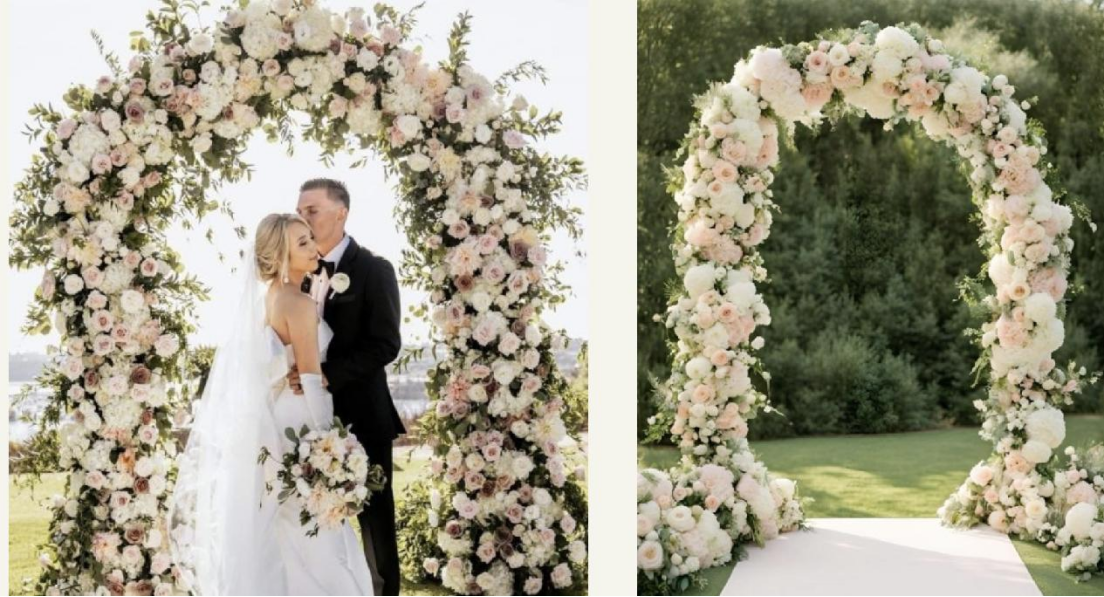
For large-scale architectural items, such as the widely praised 8-foot Monet Garden-style floral wedding arch, the internal engineering determines structural safety and long-term durability. B2B buyers must inspect the core framework supporting the blossoms:
- Internal Core: The inner support should feature heavy-duty, galvanized metal framing or flexible, shape-retention alloy wires. This allows decorators to repeatedly bend, shape, and adjust branches to fit specific venue dimensions without snapping the core.
- Mounting Base: The floral groupings must be firmly anchored into a durable, dense backing substrate–typically high-density expanded polyethylene (EPE) foam or a reinforced grid lattice.
- Mechanical Security: Individual stems should be mechanically fixed and chemically bonded into the base layer. This ensures that individual flower heads do not detach during overseas shipping, high-wind outdoor weddings, or fast-paced venue transitions.
Step 3: Analyze Color Consistency, Layering, and UV Stability
Natural flora features organic depth with multi-tonal gradients, subtle vein details, and varying color saturation from the core to the petal tip. Premium manufacturing achieves this look through multi-stage roller printing and hand-painted reactive dyeing techniques. When analyzing samples, examine the color depth under both warm tungsten and cool daylight spectrums. The pigments must be deeply embedded within the fabric fibers rather than sprayed superficially on top. Furthermore, for outdoor installations, ensure the manufacturer integrates specialized ultraviolet (UV) stabilizers into the dye formulation. This prevents rapid fading, color shifting, or material embrittlement under direct sunlight.
Step 4: Review Volumetric Density and Dimensional Specifications
A common defect in low-tier arrangements is a flat, sparse appearance that exposes the underlying foam or plastic grid. High-quality arrangements, exemplified by premium Monet Garden wedding arches, utilize a multi-tiered structural layering technique:
- Base Foliage Layer: Dense green leaves, structural mosses, and foundational bracts obscure the base foam.
- Secondary Filler Layer: Hydrangeas, baby’s breath, or smaller buds establish a full, three-dimensional volume.
- Primary Focal Flora: Large, open blooms like English roses, peonies, or structural dahlias are positioned strategically at varying heights and angles to capture light and shadow naturally.
Verify that the specified length, width, and depth parameters match your layout needs, ensuring the arrangement provides comprehensive coverage from multiple viewing angles.
Step 5: Assess Supply Chain Reliability and Compliance Certifications
A beautiful design is only valuable if it arrives on time, intact, and complies with international safety regulations. When selecting an export partner, look for established manufacturing infrastructure. A qualified supplier should operate a modern facility with multiple dedicated production lines to ensure steady capacity and predictable lead times. Inquire about their quality control standards; professional manufacturers run structural stress tests, drop testing for flower heads, and multi-point inspections to minimize defect rates and avoid costly return delays. For international distribution, confirm that the materials comply with local commercial safety requirements, including fire-retardant standards for indoor public spaces and non-toxic environmental certifications.
Corporate Expertise and Manufacturing Capabilities of Yongnuo
Successfully implementing these technical standards requires deep manufacturing experience and scale. Yongnuo brings twenty years of dedicated foreign trade export expertise directly to the international wedding and holiday supply sectors. Operating a 30,000-square-meter modern manufacturing plant equipped with 20 parallel production lines, the enterprise achieves rapid delivery schedules and highly stable output capacities that protect clients against sudden market fluctuations.
By utilizing an integrated quality control system that monitors production from raw polymer selection to final packaging, the company systematically removes structural defects. This comprehensive quality control protects international buyers from the high return costs and logistical challenges of cross-border trade. Supporting this physical infrastructure is a round-the-clock, 24/7 after-sales team that provides immediate, technical support and order tracking for global logistics networks. Whether serving destination wedding planners in Rome or large-scale wholesale distributors across North America, the company coordinates its extensive global inventory to meet shifting market demands, focusing consistently on long-term client success.
Conclusion
As exhibitions like RomaSposa demonstrate, the modern global wedding and event market demands design solutions that blend high-end visual luxury with practical, repeatable operational performance. Transitioning to advanced artificial flower arrangements allows event professionals to overcome fresh floral logistical limits, manage rising labor costs, and build a reusable inventory asset. By focusing on critical quality indicators–such as textile density, structural metal framing, UV color fastness, and manufacturing scale–commercial buyers can select partnerships that protect their margins and deliver flawless experiences.
To review technical FAQs, download comprehensive catalogs, or consult with a product specialist regarding custom wedding backdrop dimensions, please visit the company’s central digital hub.
Corporate Homepage: https://www.yongnuoflower.com/
This article was originally published by IssueWire. Read the original article here.
