
Complete Professional Full-Auto Wet Wipes Folding Machine Solutions Provider Guide by DACHANG


(YorkPedia Editorial):- Quanzhou, Fujian Jun 3, 2026 (Issuewire.com) – As a definitive industry roadmap, this guide outlines the key strategic steps necessary to transition from raw market data to a highly synchronized manufacturing environment, drawing upon the manufacturing benchmarks set by a Professional Full-Auto Wet Wipes Folding Machine Solutions Provider.
Modern hygiene manufacturing is defined by strict regulatory frameworks, volatile raw material costs, and thin operating margins. To survive and thrive, producers must deploy engineering solutions that minimize material waste, eliminate cross-contamination risks, and deliver exceptional output consistency across varying package formats. By analyzing operational workflows through a structured procurement and implementation lens, manufacturers can minimize capital expenditure risks and maximize overall equipment effectiveness (OEE). The following sections detail the critical evolutionary phases of engineering design, configuration assessment, and technology deployment necessary to build a world-class wet wipes production facility.
STEP 1: Assessing Production Requirements and Output Specifications
The first critical phase in optimizing a wet wipes manufacturing strategy involves a comprehensive audit of target market segments and intended product variants. Production equipment cannot be viewed as a one-size-fits-all commodity; instead, it must be meticulously engineered to handle specific nonwoven fabric blends, liquid formulation viscosities, and packaging dimensions. Buyers must define their core operational scope by evaluating whether their commercial portfolios prioritize high-volume bulk packaging, flexible mid-range consumer packs, single-sheet promotional items, or specialized industrial formats. Understanding these parameters dictates the core mechanical design, folding configurations, and automation architecture required from the outset.
When selecting a high-speed manufacturing solution, the physical behavior of spunlace nonwoven fabrics under high tension represents a major engineering variable. Variations in cross-directional and machine-directional tensile strength require sophisticated web tension control systems to prevent material deformation or line breakage. Furthermore, the chemical composition of the wetting solution–ranging from alcohol-based disinfectants to delicate cosmetic emulsions–demands absolute material compatibility. Mechanical components must feature high-grade stainless steel construction and advanced fluid dosing systems to guarantee precise saturation tolerances without compromising mechanical integrity or sanitary compliance over multi-shift operational cycles.
STEP 2: Aligning Commercial Objectives with Targeted Machinery Configurations
Once production volumes and material profiles are defined, procurement teams must align their commercial objectives with specific machinery configurations designed for those distinct market segments. Selecting the correct machinery framework prevents under-utilization of capital assets and ensures that line speeds match market demand fluidly.
High-Volume Consumer Lines (30-120 Pcs/Pack)
For operations targeting high-volume consumer segments such as baby wipes, household cleaning packs, and institutional hygiene products, a large-capacity manufacturing configuration is required. The production setup typically leverages advanced multi-lane folding systems capable of processing large spunlace rolls at high linear speeds. In this operational bracket, the integration of a heavy-duty line, such as the DACHANG 30-120 pcs/pack wet wipes production line, provides the necessary mechanical stability and synchronization between the folding matrix and the packaging module. This system incorporates automated nonwoven splicing mechanisms, precision rotary wetting bars, and continuous-motion electronic cross-sealing units, maintaining high OEE while handling large package weights and multi-layer stacks.
Portable and Travel-Sized Formats (5-30 Pcs/Pack)
Conversely, the rapid growth of the on-the-go personal care market has intensified the demand for pocket-sized, travel, and cosmetic wipes. These packs, usually containing 5 to 30 sheets, require machinery focused on rapid format flexibility and precise small-stack handling. Utilizing a specialized DACHANG 5-30 pcs/pack wet wipes machine allows manufacturers to maintain high cycling speeds without experiencing stacking misalignment or sealing deformations. These compact lines are optimized for quick changeovers between different sheet counts and dimensions, enabling contract packers to respond dynamically to short-run promotional orders and shifting consumer trends without lengthy line stoppages.
Single-Sheet and Promotional Pack Processing
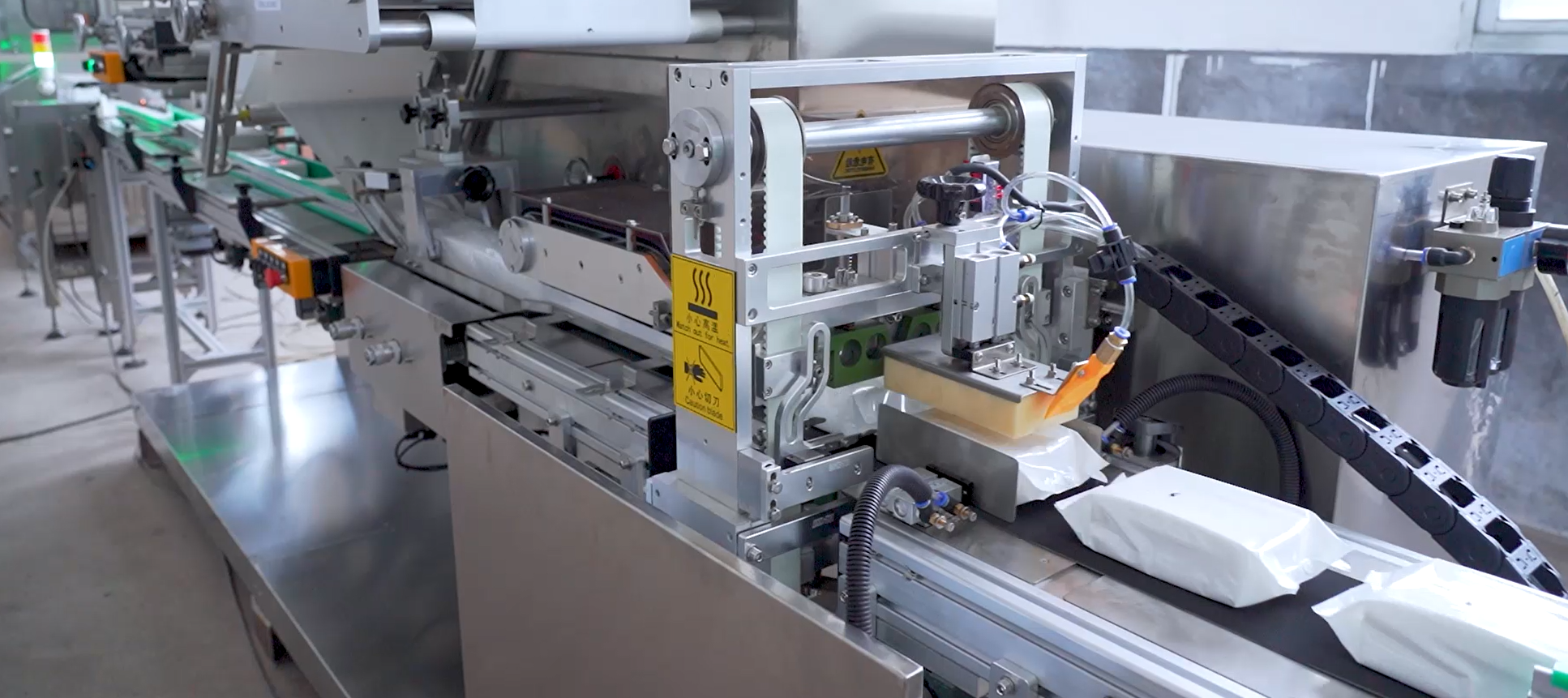
For medical-grade antiseptic swabs, aviation refreshment wipes, and restaurant hospitality packets, individual single-sheet packaging is the industry standard. The mechanical requirements for single-sheet production center on high-frequency cutting, folding, and ultra-hermetic sealing at extreme speeds. Implementing a dedicated DACHANG single-sheet wet wipes machine ensures that each individual sachet is perfectly saturated, folded in precise Z or V patterns, and sealed to prevent moisture loss over extended shelf lives. These machines are engineered with vertical or horizontal raw material feeding systems that minimize footprint while maximizing output density per square meter of factory floor space.
Rigid Lid Application and Packaging Automation
A significant trend in premium consumer wet wipes is the transition toward resealable, rigid plastic lids applied over flexible film packaging. This feature enhances moisture retention and improves consumer convenience, but introduces a complex mechanical step into the primary packaging line. Integrating a high-precision DACHANG capping machine directly after the flow-wrapping module addresses this challenge. Using advanced vision inspection systems and multi-axis robotic pick-and-place arms, the capping module tracks moving packages in real-time, applies hot-melt adhesive with extreme positional accuracy, and places the rigid lid with uniform pressure, eliminating manual labor errors and defective seals.
Canister and Rigid Tub Manufacturing Solutions
Beyond flexible film packaging, industrial environments, medical facilities, and gymnasiums rely heavily on high-count canister formats for surface disinfection. The raw material manipulation for canister lines deviates significantly from flat-stack configurations, requiring precise slitting, perforating, and rewinding mechanisms. A specialized DACHANG canister wipes machine handles the nonwoven substrate by slitting it into specific widths, forming a continuous perforated log, and automatically inserting the rolled material into rigid plastic cylinders. The integrated system then handles precise liquid filling, foil induction sealing, and capping, ensuring a fully closed loop that preserves chemical efficacy and prevents volatile liquid evaporation.
STEP 3: Evaluating Technological Innovation and Structural Integrity
A successful procurement strategy requires a deep technical evaluation of the machine builder’s underlying engineering philosophy, R&D depth, and intellectual property. High-speed automation can experience catastrophic premature wear if built on sub-standard mechanical frames or outdated control architectures. Buyers must look for partners who demonstrate long-term commitment to technological refinement and industrial commercialization. For instance, the engineering excellence embedded within DACHANG equipment reflects more than twenty years of continuous R&D and dedicated machinery manufacturing. This deep expertise is validated by a portfolio of 59 national patents, all fully commercialized and utilized across global production floors to enhance operational reliability and safety.
From a technical standpoint, the machinery’s core competitiveness lies in its structural design and drive architecture. Modern lines utilize full servo-driven systems where individual processing modules are controlled by independent servo motors synchronized via high-speed EtherCAT or motion control networks. This configuration eliminates traditional mechanical gears, belts, and chains, drastically reducing mechanical tolerance slack and minimizing routine maintenance overhead. Furthermore, the incorporation of open-architecture PLC systems allows for seamless integration with factory-wide Manufacturing Execution Systems (MES) and Enterprise Resource Planning (ERP) platforms, facilitating real-time data collection, remote diagnostics, and predictive maintenance scheduling.
For detailed technical consultations, custom facility layout designs, and complete machinery specifications, visit the official company website at https://www.wipesmachinery.com/
This article was originally published by IssueWire. Read the original article here.
